It Wasn’t the Stack, It Was a Person: What the Binance Hack Teaches Every Website Owner
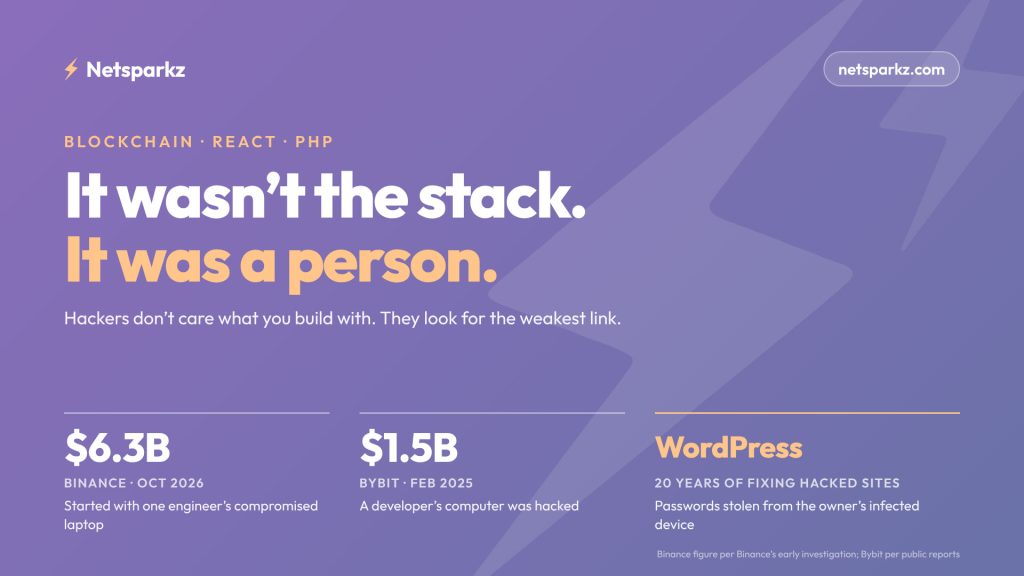
Recently, in a group meeting, a “so-called” tech expert very confidently said that PHP and WordPress are pathetic and hackable and should not be used. Just a few days after that, Binance, which is one of the biggest crypto exchanges in the world, got hacked for about $6.3 billion. This is a company that has blockchain, modern frameworks like ReactJS and the kind of security budget most companies can only dream of, and it still got hacked.
So did the tech stack fail them? Not really.
How Binance actually got hacked
According to Binance’s own early investigation, it all started with one engineer’s laptop getting compromised. Security analysts believe staff were most likely tricked into running malware that was hidden inside a fake coding test. The hackers didn’t break the blockchain and they didn’t break React. They got Binance’s own systems to sign the transactions for them. In simple words, they got in through a person.
The investigation is still going on, so some details may change, but the starting point is clear.
This is not the first time
In February 2025, Bybit lost $1.5 billion in almost the same way. A developer’s computer was hacked, and the attackers changed the JavaScript code on the website. That was JavaScript, not PHP. Two of the biggest crypto heists in history, and in both cases the way in was a person’s computer, not a weakness in the technology itself.
The same thing happens with WordPress sites
In my 20 years of working on websites, including fixing a lot of hacked ones, I have seen the same pattern with PHP and WordPress sites. Most of them were not hacked through some clever SQL injection. They got hacked because the user’s own device was infected.
A virus or some malware sitting on the site owner’s or admin’s computer steals all the saved passwords, whether it’s the WordPress admin, FTP, cPanel or email. The hacker then simply logs in as the owner and puts malware on the site. No code was broken. The hacker just walked in through the front door with the owner’s own keys.
After that, the site gets flagged by Google, the client panics, and the tech stack gets the blame. Nobody stops to ask how the hacker got the password in the first place.
No tech stack is unhackable
The thing I have learned is that hackers don’t care whether you use PHP, React or blockchain. They look for the weakest link, and most of the time that weak link is a person, be it an infected laptop, a saved password, a pirated plugin or a click on the wrong email.
How to protect your website
Most of this costs little or nothing. It just needs to be done consistently:
- Keep your devices clean. Use a good antivirus, and keep your computer and browser updated.
- Don’t save passwords in your browser. Use a proper password manager instead.
- Turn on two-factor login for WordPress, your hosting panel and your email.
- Never install pirated themes or plugins. “Nulled” plugins very often come with malware built in.
- Keep WordPress, themes, plugins and PHP updated. Updates fix the holes hackers look for.
- Give access only to people who need it, and remove old users and developers who no longer work on the site.
- Keep regular backups stored away from your server, so you can recover quickly if something goes wrong.
- Be careful with emails and attachments, especially anything urgent asking you to log in or download something.
At the end of the day
Security is not about the logo on the stack. It is about people, process and maintenance. A well-maintained WordPress site can be safer than a billion-dollar exchange that is one careless click away from being hacked.
If you’re not sure whether your website is being looked after properly, or if it has already been hacked, get in touch with us at Netsparkz. We’ve been building, securing and maintaining websites for over 20 years, and we’ll happily take a look.
Posted on LinkedIN : https://lnkd.in/p/gdxn5Sgs
Sources